Business Registration in Pakistan: A Complete Guide

Why Register a Business in Pakistan?
Pakistan’s business landscape has transformed significantly over the past decade. With a population of over 240 million, a growing middle class, and strategic positioning along the China-Pakistan Economic Corridor, the country offers compelling opportunities for both local entrepreneurs and foreign investors.
Registering your business provides legal protection, access to formal banking and financing, the ability to open corporate accounts, and eligibility for government incentives and tax benefits. Operating without registration exposes you to personal liability and limits your growth potential.
- Limited liability protection for personal assets
- Access to corporate bank accounts and financing
- Eligibility for tax credits and government incentives
- Ability to enter formal contracts and partnerships
- Easier visa processing for foreign investors
- Professional credibility with clients and suppliers
Types of Business Entities in Pakistan
Pakistan offers several business structures, each with distinct implications for liability, taxation, and governance. The choice depends on your business size, ownership structure, and growth plans.
“The entity structure you choose on day one shapes everything that follows — tax position, fundraising ability, exit options. It is worth getting right from the start.” — Uzair Saleem, Co-Founder
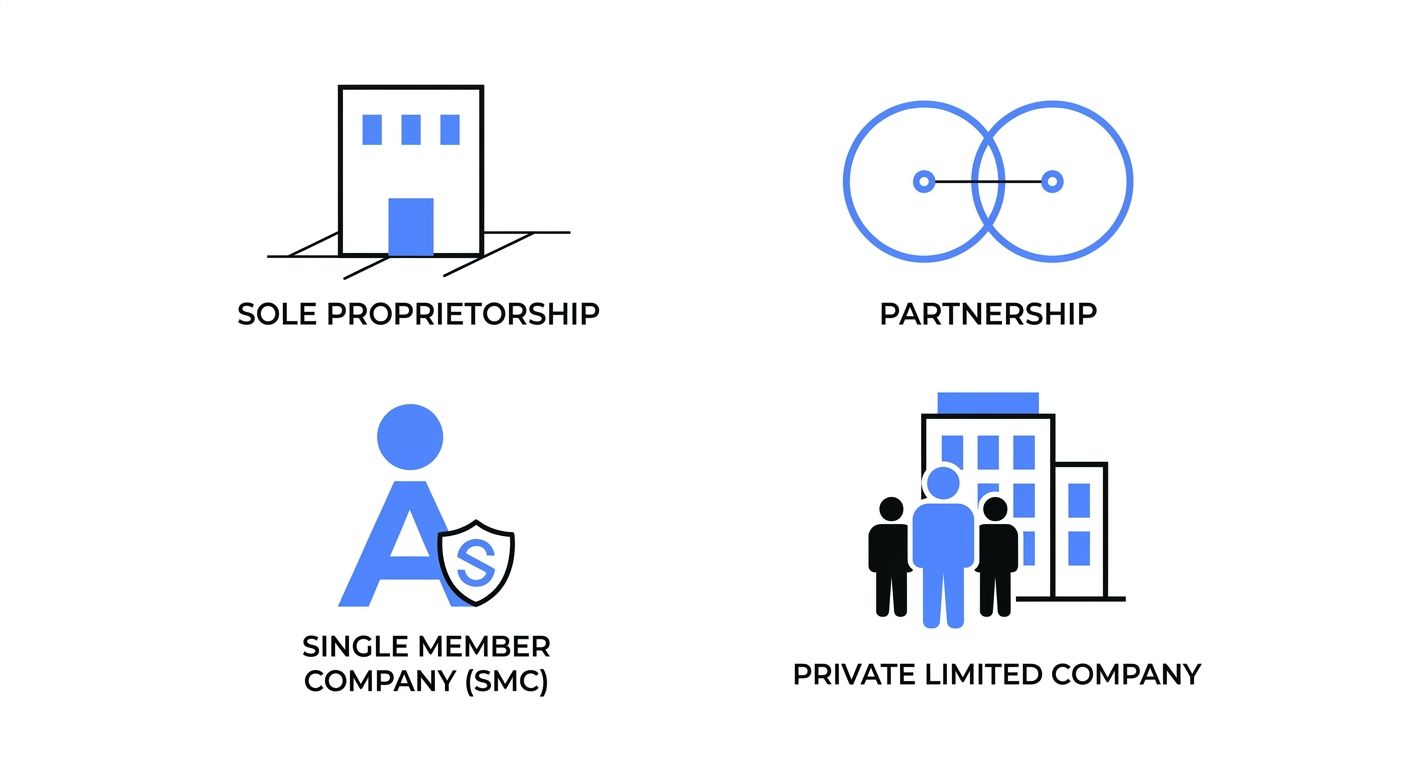
The most common structures are: Private Limited Company (Pvt Ltd) — the preferred choice for serious businesses, offering limited liability and separate legal entity status. Single Member Company — ideal for solo founders who want liability protection. Partnership — suitable for professional practices and small teams. Sole Proprietorship — simplest form, but no liability protection.
- Private Limited Company: Minimum 2 directors, 2 shareholders, limited liability
- Single Member Company: 1 director, 1 shareholder, limited liability
- Partnership: 2–20 partners, unlimited liability (unless registered as LLP)
- Sole Proprietorship: Single owner, unlimited liability, simplest compliance
The SECP Registration Process
The Securities and Exchange Commission of Pakistan oversees company registration through its online portal, e-Services. The process has been streamlined significantly in recent years and can now be completed in 2–4 weeks for most entity types.
- Digital signature (e-Signature) acquisition from SECP-approved providers
- Name reservation application (3–5 proposed names)
- Online incorporation application with supporting documents
- Payment of registration fees and stamp duty
- Issuance of Certificate of Incorporation
- Registration with FBR for National Tax Number (NTN)
- Sales tax registration (if applicable)
Required documents include: CNIC/Passport copies of directors and shareholders, Memorandum and Articles of Association, registered office address proof, and bank statements showing minimum capital. Foreign investors need to provide additional documentation including proof of residence and, in some cases, board resolutions from the parent company.
Tip: Prepare all director/shareholder documents in advance and ensure signatures are attested by an Oath Commissioner or Notary Public. Missing attestations are the single most common reason for application delays.
Tax Registration and Compliance
After SECP incorporation, tax registration is the next critical step. Every registered company must obtain a National Tax Number (NTN) from the Federal Board of Revenue and register for applicable taxes.
Sales tax registration is mandatory if your taxable turnover exceeds PKR 10 million annually. For services, the threshold varies by province under the respective Sales Tax on Services Acts. Income tax returns must be filed annually, and advance tax payments are required for certain categories of income.
- National Tax Number (NTN) registration: Required immediately after incorporation
- Sales tax registration: Mandatory if turnover exceeds PKR 10M
- Withholding tax registration: For companies making specified payments
- Professional tax: Varies by province and profession
- Workers’ Welfare Fund: 2% of taxable income for qualifying companies
Considerations for Foreign Investors
Pakistan welcomes foreign investment and has established frameworks to facilitate it. The Board of Investment (BOI) provides a one-window facility for foreign investors, and several sectors qualify for automatic approval without prior clearance.
Foreign investors can hold 100% equity in most sectors. Manufacturing companies benefit from the automatic approval route. Certain sectors — including banking, media, and aviation — require regulatory approval from the relevant authority.
Repatriation of profits and capital is permitted subject to compliance with applicable regulations and tax clearances. Pakistan has double taxation treaties with over 60 countries, providing reduced withholding tax rates on dividends, interest, and royalties.
Tip: Foreign investors should engage local legal and tax advisors before finalizing their investment structure. The right holding company jurisdiction and treaty election can significantly impact your after-tax returns.